Small Business Money Planner
The money side of your one person business in one calm system.
$3.25 $12.99
Buy on Etsy →
Business and Side Hustles
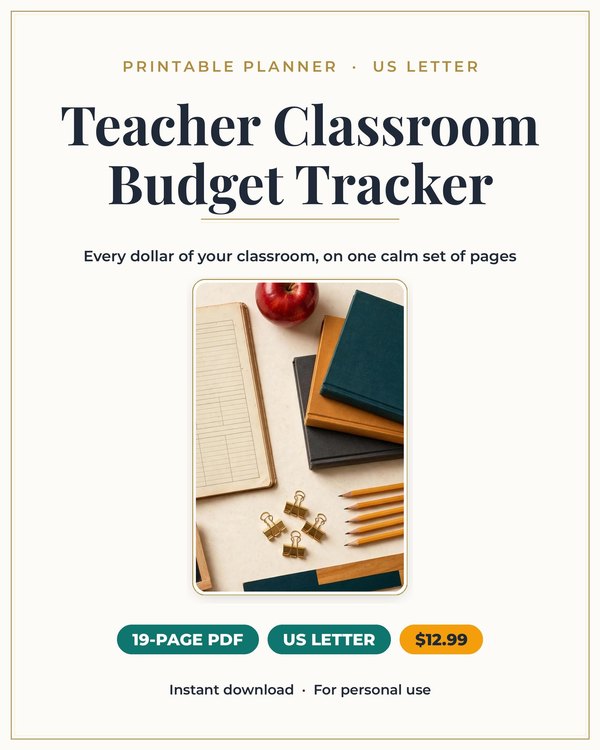
The finance planner built for teachers who spend their own money on their classrooms.
Teachers spend a staggering amount of their own money on their classrooms. Supplies, decor, books, snacks, field trips, professional development: it all adds up, and almost none of it gets tracked. By June, most teachers could not tell you what they spent, only that it was too much.
This planner exists because that money deserves the same respect as any other budget. It is a 19 page US Letter printable that gives every classroom dollar a page, from the annual budget down to the receipt log. Whether your district reimburses generously or not at all, knowing your real numbers is the first step to spending with intention instead of guilt.
This is a finance planner built specifically for teachers who spend their own money on their classrooms. It starts with an annual classroom budget that includes a cap on your own money, a number you set deliberately instead of discovering in June.
From there it covers the full school year: a monthly expense tracker, a reimbursement tracker so submitted claims stop disappearing, a donations and grants tracker, a classroom wishlist with price comparison, an educator tax deduction tracker, a receipt log, a classroom savings goal page, a field trip budget planner, and a supply inventory so you stop buying duplicates. Every tracker ships with blank write in rows. Only the one labeled worked example is filled, so every other page is yours.
The annual classroom budget page is where the year starts. You set the total, break it into categories, and write down the maximum you are willing to spend from your own pocket. That cap is the most important number in the planner. Everything else serves it.
The monthly expense tracker logs spending as it happens, category by category. The reimbursement tracker follows each claim from submission to payout, because money you are owed is money you should get back. The donations and grants tracker records who contributed what, which matters for thank you notes and for grant reporting. The educator tax deduction tracker accumulates qualifying expenses through the year so tax season is a printout, not a panic. And the supply inventory is the quiet hero: one page that stops you buying your fourth pack of dry erase markers.
Any teacher who buys classroom supplies with personal money, which is to say most teachers. New teachers setting up their first classroom get the most value, because the wishlist and budget pages turn a chaotic spending spree into a plan.
Veteran teachers use it to finally see the real annual total and to make the tax deduction painless. Teachers who run DonorsChoose projects or receive parent donations get clean records. And instructional coaches or department heads managing a shared supply budget can adapt the trackers to team spending.
Before the school year starts, print the full set and fill in the annual budget page. Be honest about the own money cap. A cap you will actually respect beats an ambitious one you will ignore by October.
Each month, log expenses in the monthly tracker as they happen. Snap a photo of receipts or jot them in the receipt log the same day. When you submit a reimbursement, open the reimbursement tracker immediately and note the date and amount. When donations arrive, log them before the thank you note goes out.
In spring, the field trip budget planner keeps the big event on budget, and the wishlist price comparison turns summer sale season into strategic shopping instead of impulse buying. Come tax time, the deduction tracker is already done.
Classroom spending is gloriously analog: receipts in your bag, supply closets, book fair flyers. A printable planner lives in that world. Keep it in your desk drawer and it is there when the Amazon box arrives.
Paper also makes the numbers feel real in a useful way. Writing down your own money total each month creates a kind of accountability no app notification can match. And the supply inventory on paper, taped inside a cabinet door, actually gets checked.
The planner is undated, so it works for any school year, and you can reprint fresh trackers every August.
Generic budget planners do not know what a classroom costs. They have no field trip page, no supply inventory, no donations tracker, and certainly no educator tax deduction log. This planner was built from the actual spending life of a teacher.
The own money cap is the philosophical core. Most planners pretend all spending is equal. This one names the uncomfortable truth, that teachers subsidize their classrooms, and builds the whole system around keeping that subsidy intentional and bounded.
And the worked example shows you exactly how to fill every page, while every tracker stays blank for your numbers. It teaches, then gets out of your way.
Download the 19 page PDF instantly and print it for the school year ahead.
Set your annual classroom budget with a firm cap on your own money, then log spending monthly.
Track reimbursements, donations, and tax deductible expenses all year, and check the supply inventory before every purchase.
What buyers ask before downloading this planner.
Yes. The educator tax deduction tracker is built around the federal deduction for eligible educators, with space to log qualifying expenses through the year. It is an organizer, not tax advice, so confirm your eligibility with a tax professional. But come tax time, you will have every receipt and total ready instead of a shoebox.
The reimbursement tracker logs every request: what you submitted, when, to whom, and whether it came back. The receipt log backs it up with a place to note each receipt. Together they mean no more wondering whether that supply order from October ever got paid back.
The supply inventory page lists what you already own, so you check it before you buy. The classroom wishlist with price comparison keeps wants in one place with prices from different stores, which stops both duplicate buying and impulse spending.
Print the full 19 pages at the start of the school year and keep them in a slim binder or folder at your desk. Fill in the annual budget first, then use the monthly tracker as you spend. The receipt log works best if you jot entries the day you buy, not at the end of the month.
Yes. The donations and grants tracker is built for exactly that: who gave what, what it was earmarked for, and what you still need. The wishlist page doubles as a shareable list for classroom donors.
Planners from the same collection, built to work together.
The money side of your one person business in one calm system.


Know your real profit per show, not just what sold.
Join the list and get the free monthly budget worksheet plus first word on new planners.
No spam, ever. Unsubscribe anytime.