
Doctor Visit Prep Printable
Walk in with your history, meds, and questions on one page.
$2.50 $9.99
Buy on Etsy →
Health and Caregiving
Track symptoms, map pain, and walk into appointments with real records.
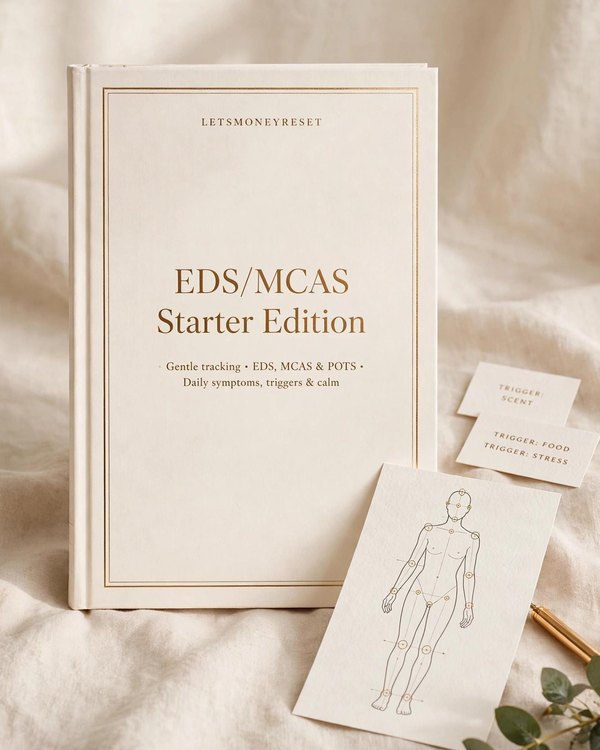
Living with Ehlers Danlos syndrome or mast cell activation syndrome means living with symptoms that shift daily and doctors who do not always connect the dots. This 57 page printable binder is built for that reality. It gives you one place to track what your body does, map where it hurts, organize your records, and prepare for appointments, so you walk in with evidence instead of trying to explain months of symptoms from memory.
The binder is called a starter for a reason. It assumes you are early in the process of getting organized, maybe newly diagnosed, maybe still fighting for a diagnosis. It does not assume you already have a system. It builds one with you, page by page.
Pain from EDS moves. A shoulder acts up on Tuesday, a hip aches on Thursday, and by the appointment on Friday you are describing it from memory and getting the details wrong. The front and back body pain maps let you mark exactly where it hurts, when, and how badly, right when it happens.
Over weeks those maps become a visual record no verbal description can match. You can point to the page and say here is where it has been hurting and here is how often. For conditions where pain is the main symptom and also the easiest thing for a doctor to dismiss, that page is powerful.
The daily symptom trackers are the engine of the binder. Each day you log the symptoms that showed up, their severity, and anything notable like a reaction, a flare, or a dislocation. It takes a few minutes and it builds the dataset everything else runs on.
The weekly and monthly review pages are where the data turns into insight. Patterns show up at that scale that you cannot see day to day: the foods that trigger reactions, the weather that precedes a flare, the slow improvement after a treatment change. Reviews turn tracking from a chore into a tool.
Most chronic illness patients know the feeling of leaving an appointment and remembering the three things they forgot to say. The appointment prep pages fix that. Before each visit you write down your top concerns, your questions, and what has changed since last time. You walk in with an agenda instead of hoping you remember.
The self advocacy pages go further. They help you put your experience into language that lands in a clinical setting: what you need, what has not worked, what you want tried next. And the about me summary page gives every new provider a one page brief on your conditions, medications, and history, so you stop retelling your whole story from scratch.
This binder is for people living with Ehlers Danlos syndrome, MCAS, or both, who are tired of being disbelieved or dismissed. It is especially useful if you are newly diagnosed and building your first real system, or if you are still seeking a diagnosis and need organized records to make your case.
It also works for caregivers and parents tracking a child's symptoms. The records organizer keeps test results, imaging, and referral letters in order, so the binder becomes the complete file you bring everywhere instead of a folder of loose papers.
Download the PDF and print the binder. Start with the about me page and the records organizer.
Each day, log your symptoms on the daily tracker and mark the pain maps when pain shows up.
Before every appointment, fill in the prep pages and bring the binder so your records speak for you.
What buyers ask before downloading this planner.
No. This is an organizational tool for tracking your own symptoms and records. It does not diagnose, treat, or advise on any condition. Work with your doctors on all medical decisions.
Both are 57 page starter binders with the same structure, but this one is built around EDS and MCAS: body pain maps for joint and tissue pain, and symptom tracking shaped around flares and reactions. The POTS version centers on heart rate logging instead.
Yes, and that is one of its best uses. Organized symptom records with dates and patterns are exactly what help doctors take you seriously and reach a diagnosis faster.
A few minutes. The daily pages are designed to be filled in quickly, and the reviews happen weekly and monthly, not daily.
The structure works for any condition with shifting daily symptoms, but the pain maps and tracking categories were designed for EDS and MCAS specifically.
It is a printable PDF. Print the pages you use most and keep them in a binder. You can also import it into a tablet annotation app and fill it in with a stylus.
Planners from the same collection, built to work together.
Walk in with your history, meds, and questions on one page.

Show your doctor real data, and walk in believed.

Fight insurance denials with a case file, not a shoebox.
Join the list and get the free monthly budget worksheet plus first word on new planners.
No spam, ever. Unsubscribe anytime.