Sunday Scaries Reset Kit
Beat Sunday night dread and rest before the work week.
$2.50 $9.99
Buy on Etsy →
Focus and Mind
Know your triggers and your plan before you need it.
A trigger does not ask permission. It shows up on a bad day, in a familiar place, at a familiar hour, and suddenly the plan you meant to follow is gone. The time to decide what to do is not in that moment.
This printable plan has you write it all down while you are calm: your triggers, your warning signs, and exactly what you will do when they show up.
Fill it in on a good day so it is ready on a bad one. That is the entire strategy.
The trigger inventory walks you through naming your triggers honestly: people, places, emotions, times of day, anniversaries. Naming them takes away their surprise.
The warning signs section captures your personal early signals: the thoughts, feelings and behaviors that show up before a slip. Everyone's signals differ. Writing yours down means you can spot them.
The coping plan turns each trigger into an if then step. When this trigger shows up, I will do this instead. Specific steps, written in your own words.
The one page plan puts the essentials together: your top triggers, your coping steps, and your support contacts, all on a single page you can reach fast.
Keep it in your wallet, your phone case, your nightstand, wherever you will actually look. A plan in a drawer helps no one.
The support contacts section keeps names and numbers on the same page as the steps. When you need help, reaching out should take seconds, not a search through your phone.
A printable plan works because it is physical and personal. You wrote it in your own hand on a calm day. That carries weight in a hard moment in a way a generic list never will.
Revisit the plan regularly. Triggers change as life changes. Update the pages when something new shows up or an old trigger fades.
Print fresh copies whenever you need them. The plan should match your life as it is now, not as it was six months ago.
This plan is for anyone in recovery who wants their coping strategy written down before they need it: sobriety, habit change, any pattern you are working to break.
It suits people who know their triggers in theory but have never written the response plan. The writing is the work.
This is a personal planning tool, not treatment and not medical advice. It supports recovery work. It does not replace professional help, and in a crisis, contact emergency services or a crisis line.
Triggers are not fixed. A new job, a move, a relationship change, a loss: life shifts and the trigger list shifts with it. A plan written a year ago may miss the thing that matters now. Revisit the pages every few months and ask what is new.
Updating is also how you notice progress. A trigger that once felt overwhelming may now feel manageable. Seeing that change on paper, in your own handwriting, is real evidence of growth. Keep the old pages when you reprint so you can see how far the plan has come.
Share the updated plan with someone you trust if that feels right. A plan that lives only in your head is easy to abandon. A plan someone else has seen carries a gentle accountability that helps on the hard days.
This plan works best alongside real support: a sponsor, a counselor, a group, a trusted friend. Paper is a tool, not a replacement for people. The support contacts section exists because reaching out is usually the bravest and most effective step.
If you slip, the plan is still there. Update the warning signs section with what you learned and keep going. A slip is information, not a verdict. The plan does not judge. It just waits for you to pick it up again.
On a calm day, write your triggers, warning signs and coping steps on the plan pages.
Put your support contacts on the one page plan and keep it where you can reach it fast.
When a trigger shows up, open the plan and follow the steps you wrote for yourself.
What buyers ask before downloading this planner.
Fill it in when you are calm. The plan only works if it is written before you need it, so do it on a good day and keep it somewhere you can reach fast.
Yes. Keep the one page plan where you will actually see it: a wallet, a phone case, a nightstand, a binder.
The warning signs section is built for that. Write your personal early signals so you can catch the slide before it becomes a crisis.
Yes. The support contacts section keeps names and numbers on the same page as the plan, so reaching out takes seconds.
This is a personal planning tool, not treatment and not medical advice. If you are in crisis, contact emergency services or a crisis line right away.
Planners from the same collection, built to work together.
Beat Sunday night dread and rest before the work week.
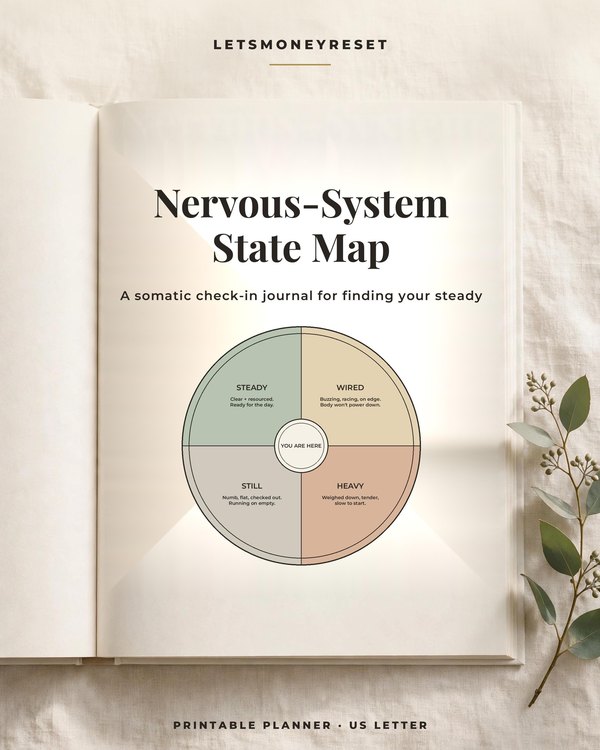
Notice how you feel, and choose what helps.
Small, sturdy tools for the moment you need them.
Join the list and get the free monthly budget worksheet plus first word on new planners.
No spam, ever. Unsubscribe anytime.