Sunday Scaries Reset Kit
Beat Sunday night dread and rest before the work week.
$2.50 $9.99
Buy on Etsy →
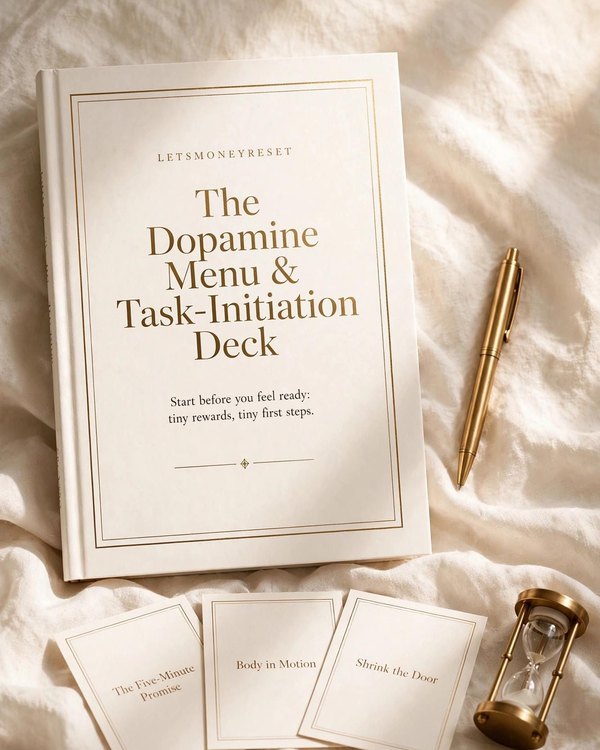
Focus and Mind
For people who know exactly what to do, but can't start.
A dopamine menu is a personal list of activities sorted by how much time and energy they take, so that when your brain is stuck you can pick something that fits your current state instead of staring at a to do list. It works with your brain instead of against it: low energy gets a low energy option, five free minutes gets a five minute option.
This toolkit gives you a structured dopamine menu in five time bands: under 5 minutes, 5 to 15 minutes, 15 to 30 minutes, 30 plus minutes, and a dedicated low energy band for the days when even small tasks feel enormous. You fill each band with your own activities, so the menu always reflects your real life.
Knowing what to do is rarely the problem. Starting is the problem. The 12 task initiation cards are built for that exact moment of paralysis: each card gives you one concrete way to take the first step, like shrinking the task to its first five minutes, changing your environment, or pairing the task with something your brain already wants to do.
Keep the cards somewhere visible, on your desk, on the fridge, in your planner. When you catch yourself scrolling instead of starting, pull a card and do only what it says. The whole system is designed around the idea that starting badly beats not starting at all.
Beyond the menu and the cards, the toolkit includes friction audit worksheets that help you find exactly where a task gets stuck, and task breakdown ladders that split overwhelming projects into steps small enough to start. The first five minutes starters give you opening moves for common stuck moments.
You also get an activation energy scale for rating how much effort a task will really take, a starter ritual builder for creating your own pre task routine, an initiation wins log for recording every start so your brain learns that starting leads somewhere good, and a Stuck Right Now SOS page for emergencies.
This is for adults with ADHD who are tired of productivity systems built for neurotypical brains. It is for the person with seventeen open tabs, a to do list from last month, and a brain that knows exactly what matters and still cannot begin. It is also for anyone who experiences task paralysis, whether or not they have a diagnosis.
Students, freelancers, parents, and professionals all use it differently. A student might lean on the breakdown ladders for assignments. A freelancer might live in the dopamine menu between client projects. The tools are flexible because stuck looks different for everyone.
Task initiation tools need to be visible at the moment of stuckness, not buried in an app behind a notification you will swipe away. Printed cards on your desk are there when you look up from your phone. A printed dopamine menu on the wall is there when your brain goes blank.
The PDF also loads into any tablet note app if you prefer digital, so you get both options. Print the cards on cardstock for durability, print the worksheets on regular paper, and reprint anything you fill up. No subscription, no account, no updates that rearrange the interface you just learned.
Planners organize tasks. This toolkit starts them. A planner tells you the report is due Thursday; these cards help you open the document on Tuesday when your brain would rather do anything else. It fills the gap that every planner leaves open.
It is also honest about energy. Most systems pretend every hour is equal. The five time bands and the activation energy scale admit that you are a different person at 9am and 9pm, and give you tools calibrated for both versions.
Download the 50 page PDF, print the cards on cardstock and the worksheets on regular paper, or load it into a tablet note app.
Fill in your personal dopamine menu across the five time bands with activities from your real life.
When you are stuck, pick a task that fits your energy and time, pull an initiation card, and take only the first step.
What buyers ask before downloading this planner.
A list of activities you enjoy or find satisfying, organized by how much time and energy each one takes. When your brain is understimulated and you cannot start a task, you pick a menu item that fits your current energy instead of defaulting to scrolling. This toolkit gives you the structured template in five time bands plus guidance on filling it with your own items.
No. The tools address task paralysis and difficulty starting, which many people experience with or without a diagnosis. If you recognize yourself in the description, the toolkit will make sense to you.
Whichever you will actually look at when stuck. Many people print the cards for visibility and keep the worksheets digital, or vice versa. The PDF works both ways, so experiment and keep what sticks.
A to do list tells you what needs doing. This toolkit addresses the moment between knowing and doing. The initiation cards, friction audits, and breakdown ladders are all built for the starting problem that to do lists ignore.
Adults and older teens. The language and examples assume an adult life of work, school, or household tasks. Younger kids would need a parent to adapt it.
No. It is a set of practical paper tools, not treatment. Many people use it alongside professional support, and the wins log in particular pairs well with strategies learned in therapy or coaching.
Planners from the same collection, built to work together.
Beat Sunday night dread and rest before the work week.
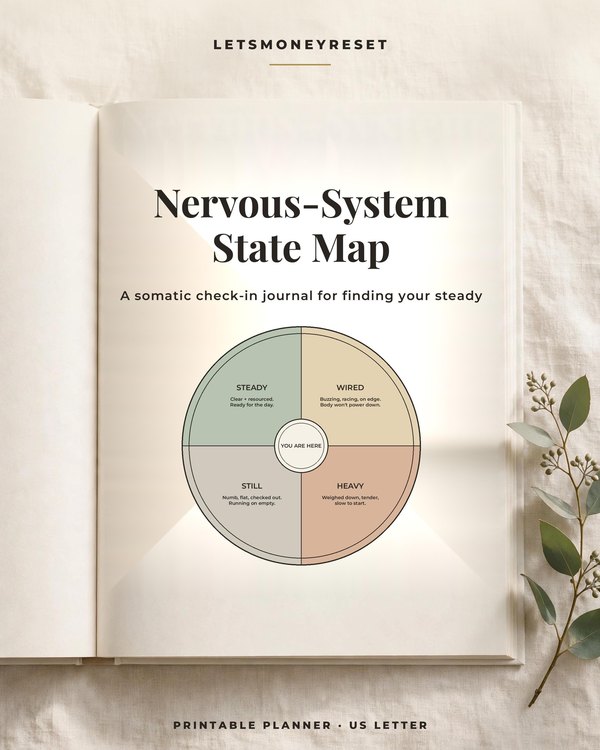
Notice how you feel, and choose what helps.
Small, sturdy tools for the moment you need them.
Join the list and get the free monthly budget worksheet plus first word on new planners.
No spam, ever. Unsubscribe anytime.